5.2.1. Program Manager
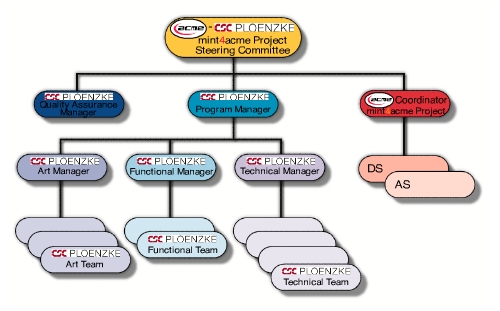
We will appoint a Program Manager to lead the project team and communicate with the ACME project leader.
The Program Manager will be responsible for the planning, controlling and reporting of the project and its status according to ISO9001. He reports regularly (i.e. monthly) to the steering committee on:
- The progress of the project within the last period
- The actual status of the project
- Any problems within the last period
- The activities for the next period
5.2.2. Quality Assurance Manager
We will appoint a Quality Assurance Manager for the MINT project, who will put in place appropriate control points to ensure that the necessary quality will be delivered by the project team as agreed with the client and that the status of critical success factors for the project is recorded and reported to the steering committee.
5.2.3. Technical Manager
The technical manager is responsible for all technical aspects as well as the development team. This highly demanding task becomes even more complicated when the project plan must be adapted due to new requests.
5.2.4. Functional Manager
The functional manager is leading the team which is responsible for engineering the relevant processes and sub-processes. The project can only be successful if there is a seamless integration of all processes covered by the MINT application.
5.2.5. Art Director
MINT is a new kind of application which combines application development as well as publishing. To achieve an outstanding quality level there must be an art director responsible for the art team.
Project Team Structure in 1997
In 1997, the concept of dividing project leadership between technical, functional, and design roles was somewhat innovative. Traditional software development at the time often used a more rigid hierarchy with a single project manager and technical leads, without explicitly positioning design leadership at the same level.
The reference to ISO9001 reflects the increasing importance of formal quality management systems in software development in the late 1990s. The prominence given to the Art Director role highlights the recognition that web applications required both technical engineering and creative design leadership—a concept that would eventually evolve into today's UX/UI leadership positions.
This section is in development as part of the digital archaeology restoration project.
The complete content for Project Team will be expanded in a future update.